Overview
A positioner (also called a turnover machine, rotary table, turnover work platform, etc.) usually refers specifically to a welding positioner, an auxiliary device for welding robots. During robotic automatic welding, it helps the workpiece rotate back and forth, tilt, or turn over, adjusting the weld seam to the flat or boat position so the welding torch can quickly and accurately align with the weld joint. This greatly reduces welding difficulty, stabilizes weld formation quality, improves production efficiency, lowers labor costs, and reduces health hazards to operators.
The structure of a positioner typically includes a base, table, fixture, servo motor, and control system. By achievable motion, it can be classified as single-axis, dual-axis, triple-axis, and C/H/L/M/T/U/X types, among others. By power source, it can be servo-driven or AC variable-frequency-driven. Its applications are broad, mainly including metal welding, machining, assembly, and surface treatment, and it is often used with arc welding, laser welding, submerged arc welding, and other processes.
Our positioners feature high load capacity, high positioning freedom, high positioning accuracy, good stability, and multiple functions. They can meet the needs of different welding processes and workpiece shapes, and special models can be customized according to customer requirements. The equipment supports coordinated control with mainstream welding robots (external axis coordination), reserves a 15%–30% safety load margin, and can accommodate eccentric, extra-long, and irregular heavy workpieces. It is widely used in automotive, construction machinery, new energy, steel structure, pressure vessel, and other industries.
Capacity: 250kg-140,000kg
Rotary Angle: ±180° or ±360°
Rotary Speed: 50°/S
Customizable, Available for OEM
Place of Origin: Guangzhou, China
Product Gallery
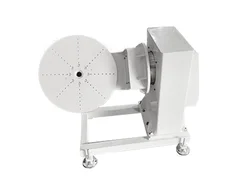
Single-Axis Positioner
Details & Specs
| Parameter | Standard Series (Single / Dual Axis, Light-to-Medium Payload) | Heavy-Duty · Custom Series (Tri-Axis / Compound / Gantry Type) |
|---|---|---|
| Rated Payload | 250 – 1,000 kg | Custom-built to order, up to 140,000 kg (140 tons) |
| Rotation / Tilt Radius | 400 – 600 mm | Custom-built to part dimensions |
| First-Axis Tilt Angle | ±180° | Customized to application |
| Second-Axis Tilt Angle | ±360° | Customized to application |
| First-Axis Rated Speed | 50°/s | Customized to application (lower speed for greater stability) |
| Second-Axis Rated Speed | 70°/s | Customized to application |
| Repeat Positioning Accuracy | ±0.10 mm (standard model) | Customized by model; precision models up to ±0.05 mm / ±0.05° |
| Drive Method | Servo motor drive (external-axis synchronization supported) / AC variable-frequency drive (hydraulic optional for heavy-duty models) | |
| Power Supply & Rating | 3-phase 380V 50Hz, 0.5 kW – 100 kW | |
| Approximate Weight | 800 – 2,000 kg | Customized by model (heavier for heavy-duty) |
| Approximate Dimensions | 1,000 × 1,000 × 1,500 mm | Custom-built to site layout |
| Optional Features & Accessories | Safety guards, fixtures, turntables, pneumatic clamping, dual-station alternating structure, safety light curtains | |
| Industry Applications | Automated welding, machining, assembly, surface treatment (automotive, construction machinery, new energy, steel structures, pressure vessels, etc.) | |
Core Advantages
Positions the weld seam for flat or horizontal-vertical (ship-shape) welding, reducing defects and stabilizing bead formation—boosting robot cycle rates by more than 30%.
Servo drive + full closed-loop control delivers repeat positioning accuracy of ±0.10 mm; precision models reach ±0.05 mm / ±0.05°.
Single-, dual-, and tri-axis plus C/H/L/M/T/U/X configurations, covering circumferential seams, enclosures, frames, and extra-long irregular parts.
Supports mainstream industrial bus protocols and external-axis synchronization, moving in sync with arc-welding / laser-welding robots.
High payload capacity, excellent rigidity, and smooth operation; 15% – 30% safety load margin accommodates offset or extra-long workpieces.
Custom structures, payloads, and accessories built to your parts and process; dual-station alternating configurations available, plus OEM production.
Custom Engineering & OEM
We customize the positioner's number of axes, payload, rotation / tilt angles, speed, and drive method based on your workpiece weight, geometry, weld seam locations, and production-line robot configuration. Optional add-ons include pneumatic clamping, safety guards, turntables, dual-station alternating structures, and safety light curtains. We support synchronized integration with mainstream welding robots from ABB, KUKA, FANUC, Yaskawa, and others, and also accept build-to-print and build-to-sample OEM volume production, backed by complete technical documentation and on-site commissioning support.